
Products
Synthesis
Turn hundreds of research papers into a structured research database.
Research Infrastructure • LearnzyLabs
An internal tool built while developing the Focus Score layer of Learnzy.
Product Link
| Status | 🟢 Active |
| Category | Research Infrastructure |
| Built By | Himanshu Gupta |
| Role | Solo Builder |
| Stack | React · TypeScript · Supabase · Gemini |
| Purpose | Structured Literature Extraction |
Overview
Synthesis is an internal research infrastructure tool built inside LearnzyLabs while researching the Focus Score layer of Learnzy.
During literature reviews I realized the bottleneck wasn’t reading papers—it was comparing them.
Every paper described similar ideas using different structures, making it difficult to identify patterns across hundreds of studies.
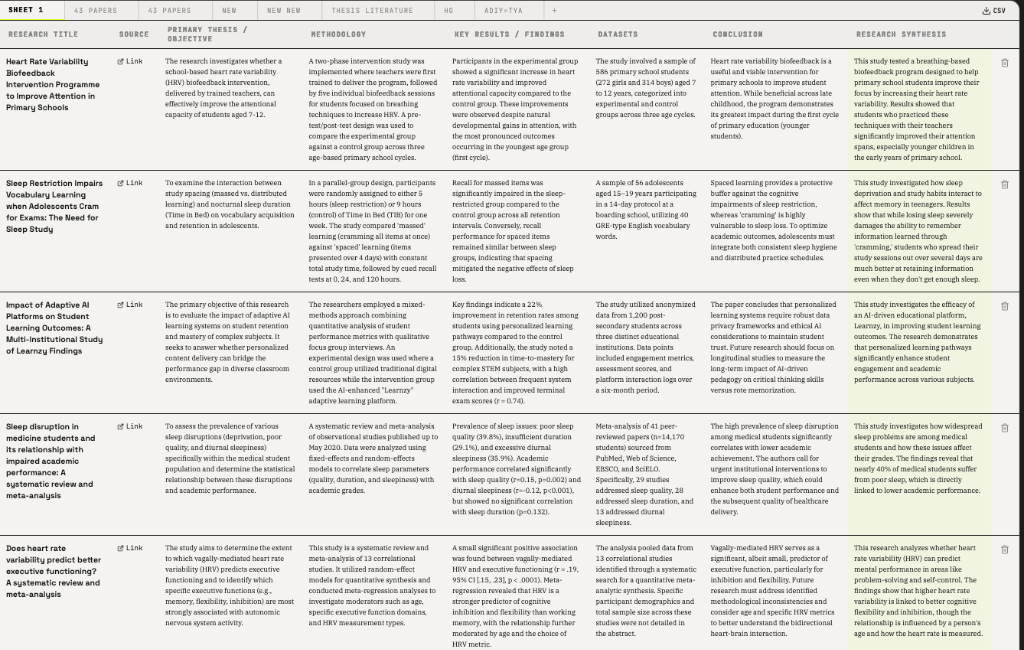
Synthesis converts academic papers into a standardized research matrix, allowing literature to be searched, compared, exported and reused as structured knowledge.
Why I Built It
While researching physiological readiness and student performance, I found myself reading hundreds of papers.
The difficult part wasn't understanding the papers.
The difficult part was comparing them.
Every paper answered similar questions but presented information differently.
I wanted every paper to have the same structure.
That became Synthesis.
Why This Project Matters
Synthesis wasn't built as a standalone product.
It was built because I repeatedly encountered the same bottleneck while researching physiology and student performance.
Rather than accepting that workflow, I built an internal tool to remove it.
Many projects inside LearnzyLabs begin this way.
Features
Research Ingestion
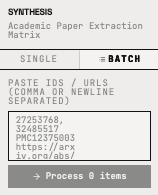
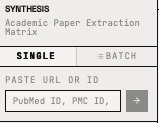
- Single paper import
- Batch processing
- PubMed support
- PMC support
AI Extraction
- Structured schema extraction
- AI-generated synthesis
- Metadata extraction
Research Workspace
- Spreadsheet matrix
- Multiple workspaces (Tabs)
- CSV export
Screenshots
How It Works
Research Paper
      ↓
   Scraping
      ↓
   Extraction
      ↓
Structured Academic Schema
      ↓
  Research Matrix
      ↓
   CSV Export
Architecture
React
  ↓
Supabase
  ↓
Edge Function
  ↓
Gemini
  ↓
Database
  ↓
Matrix UI
The application separates ingestion, extraction and visualization into independent stages, allowing each component to evolve without affecting the rest of the system.
Tech Stack
Frontend
- React
- TypeScript
- Vite
- Tailwind CSS
Backend
- Supabase
- Edge Functions
AI
- LLM-powered structured extraction
Design Philosophy
Most research tools optimize for reading papers.
Synthesis optimizes for comparing papers.
Reading one paper rarely changes your understanding.
Comparing hundreds often does.
By transforming papers into structured data instead of free-form summaries, researchers can identify patterns, contradictions and gaps much more efficiently.
Lessons Learned
The biggest bottleneck in research isn't reading.
It's organizing knowledge.
Once research becomes structured data instead of text, it becomes searchable, comparable and reusable.
That realization has influenced how I design products beyond Synthesis.
Roadmap
Intelligence
- Contradiction detection
- Research gap detection
- Semantic search
Visualization
- Citation graph
- Research graph
AI
- Literature review generation
- AI chat over research